

Choosing a diamond is an important decision. Beyond its brilliance, several criteria determine its quality and value.
To professionally evaluate a diamond, we rely on what are called the 4Cs: Cut, Color, Clarity and Carat.
The size
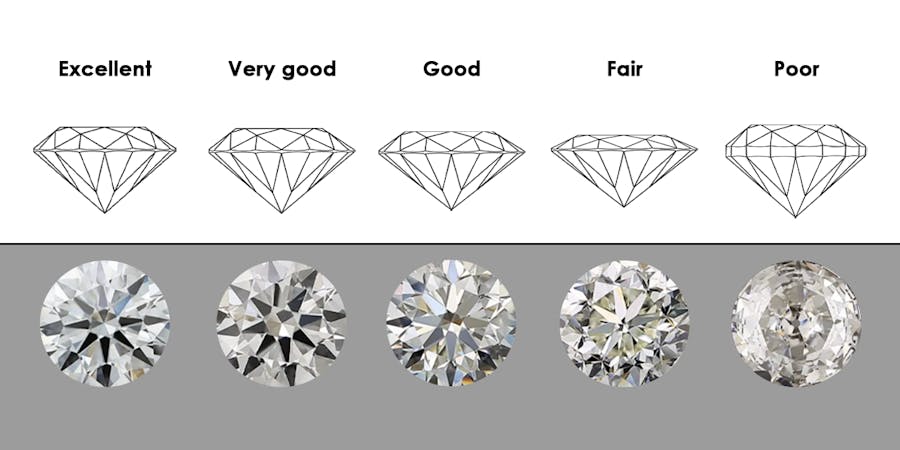
Contrary to popular belief, the quality of a diamond depends primarily on its size (and not its weight).
Size corresponds to proportions, symmetry, and polishing.
An excellent size allows light to enter from the top, reflect inside and then exit towards the eye.
This phenomenon is what creates the brightness, the fire, and the sparkle.
A poorly cut diamond will appear dull , even if it is of very good quality.
For a round diamond, choose a quality of " Excellent " or " Very good ".
The color
White diamonds are classified in alphabetical order from D to Z :
- DEF: completely colorless
- GH: very slightly tinted white (almost invisible to the naked eye)
- IJ: slight perceptible tint
Beyond that: a more pronounced shade
In most high-end creations, colors D to H are generally chosen, depending on the budget and the desired result.
A perfectly colorless diamond reflects more light.

The color for colored diamonds
Obviously, colored diamonds (pink, blue, yellow, etc.) are not classified in this way . The D to Z scale only applies to white diamonds.
The typical classification for colored diamonds is:
Faint - Very Light - Light - Fancy - Fancy Intense - Fancy Vivid - Fancy Deep - Fancy Dark
For example :
A diamond can be certified:
Fancy Vivid Pink

Purity
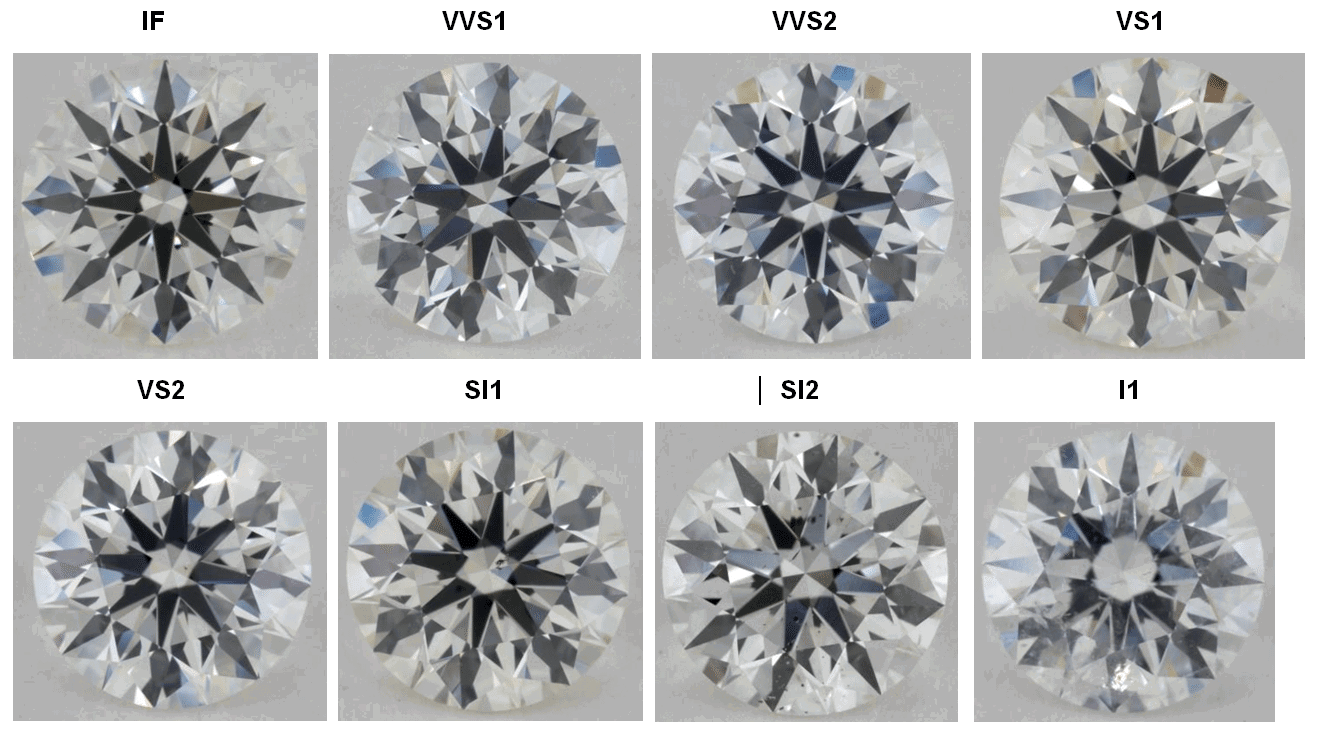
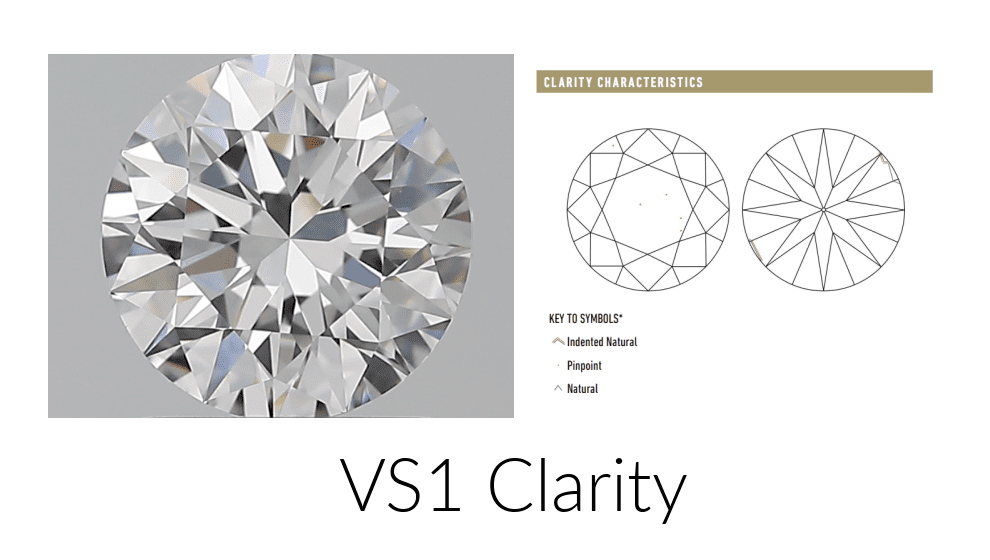
Purity assesses the presence of internal inclusions or small surface marks.
The classification:
- IF (Internally Flawless)
- VVS1 / VVS2
- VS1 / VS2
- SI1 / SI2
Below that level, the diamonds become far too embedded to look good. I advise you to stay at the levels above.
To the naked eye, a VS diamond generally appears perfectly clean.
It is not always necessary to aim for the highest grades: the important thing is that it is “eye clean” (no inclusions visible without a magnifying glass).
The weight (carats)
The carat corresponds to the weight of the diamond.
1 carat = 0.20 grams.
This applies to all stones, not just diamonds.
The greater the weight, the more the price increases exponentially.
A smaller but well-cut diamond can appear brighter than a larger, poorly proportioned diamond.
The choice of carat weight for your stone depends on your desires, the design of your jewelry, and your budget.

The certificate: an essential element
A quality diamond is usually accompanied by a certificate issued by a recognized independent laboratory.
The most reputable laboratories are: Gemological Institute of America (GIA), HRD Antwerp and International Gemological Institute (IGI)
The certificate details:
- The 4Cs
- The exact proportions
- The mapped inclusions
- Fluorescence
It guarantees a neutral and professional assessment.
In summary
A quality diamond depends on the balance between:
- An excellent size
- A color that suits the project
- A purity invisible to the naked eye
- A consistent weight
- A reliable certificate
It is not just a number on a piece of paper, but an overall harmony.